
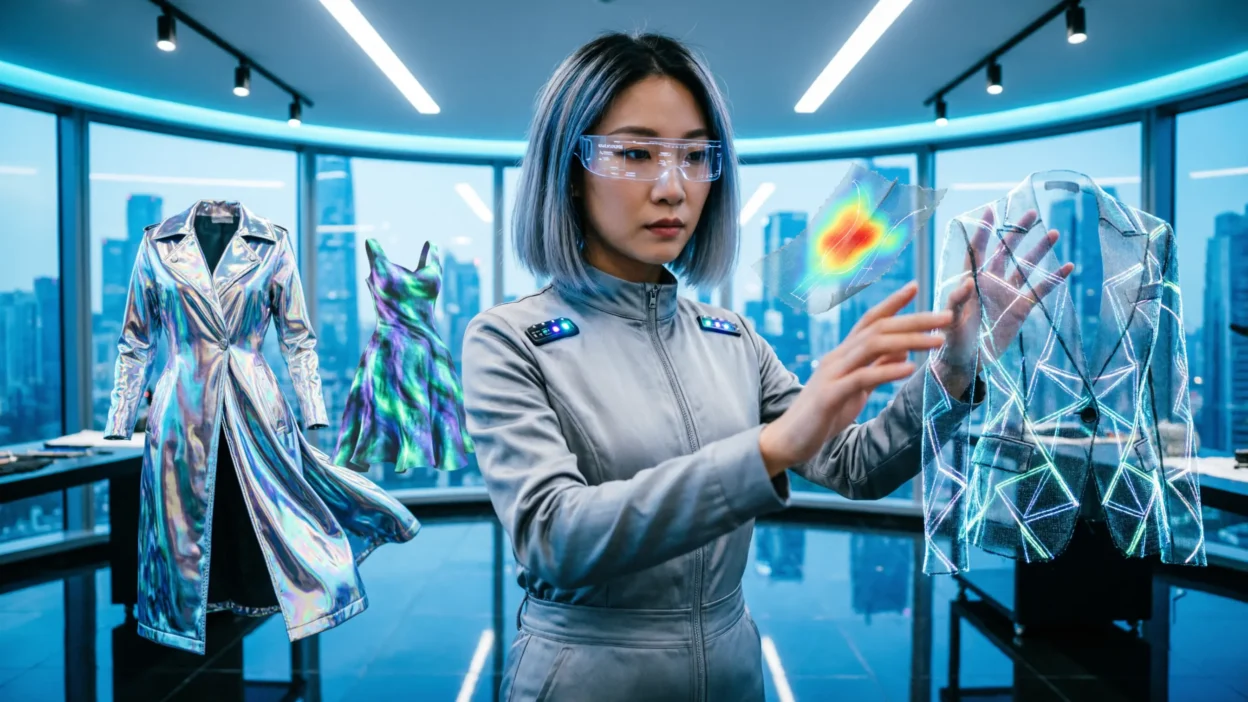
Fashion used to rely on sketches, fabric samples, and weeks of trial and error. Today that process is changing fast. AI clothing technology now helps designers generate ideas, simulate fabrics, forecast trends, and even predict what customers want to wear next season.
The rise of Artificial Intelligence in Fashion has reshaped how clothing moves from concept to closet. Designers use algorithms to create garments. Brands analyze consumer data with machine learning. Virtual models try on outfits before a single thread gets stitched.
This guide explores the entire ecosystem behind AI in Clothing Design. You’ll learn how modern tools work, what technologies power them, and why the fashion industry is rapidly adopting AI-Powered Fashion Design systems.
What Is AI Clothing?
AI clothing refers to garments designed, modeled, or optimized using Artificial Intelligence (AI) technologies. These systems analyze massive datasets and generate design options that would take humans weeks to produce.
Instead of sketching every design manually, designers collaborate with AI tools that produce ideas, simulate fabrics, and refine garment structures.
At its core, AI clothing blends:
- Machine Learning
- Computer Vision
- Generative AI
- Computer-Aided Design (CAD)
- 3D Modeling and Simulation
Together these technologies form modern Intelligent Clothing Design Systems.
Definition of AI Clothing
In simple terms, AI-Based Garment Design involves software that helps create clothing using data-driven algorithms.
These systems can:
- Generate clothing concepts
- Predict fashion trends
- Optimize patterns
- Simulate fabrics digitally
- Personalize clothing for individual body types
Many fashion houses now integrate AI-Driven Apparel Design into their workflow because it dramatically speeds up development.
How Artificial Intelligence Works in Fashion Design
Modern AI Fashion Design Technology relies on several technical systems.
| Technology | Role in Fashion |
|---|---|
| Machine Learning | Predicts fashion trends and consumer behavior |
| Computer Vision | Recognizes clothing images and attributes |
| Generative AI | Creates new clothing designs |
| Deep Learning | Improves garment simulation accuracy |
| Predictive Algorithms | Forecasts demand and production needs |
These systems train on huge AI Model Training Datasets containing millions of fashion images and product attributes.
For example:
- DeepFashion Dataset
- Fashion-Gen Dataset
- Annotated clothing image datasets
- Consumer purchase history data
The more data the system sees, the smarter the design suggestions become.
Evolution of Fashion Technology
Fashion design has gone through several technological phases.
| Era | Main Technology | Design Method |
|---|---|---|
| Traditional Fashion | Hand Sketching | Manual design and prototyping |
| Early Digital Fashion | Computer-Aided Design (CAD) | Digital pattern drafting |
| Modern Fashion | AI-Powered Fashion Design | Algorithm-assisted design |
Today designers combine Digital Fashion Design, AI algorithms, and 3D simulation tools.
The result is a fully digital clothing workflow.
Core Technologies Powering AI Clothing Design
Behind every AI fashion design system sits a sophisticated technology stack.
These technologies transform ideas into realistic garments faster than ever before.
Artificial Intelligence and Machine Learning
At the heart of Artificial Intelligence in Fashion lies Machine Learning.
Machine learning models study fashion data such as:
- runway collections
- social media images
- consumer purchases
- clothing catalogs
Using these patterns, algorithms predict upcoming trends and generate design ideas.
Modern Neural Networks can recognize thousands of clothing attributes including:
- sleeve types
- fabric textures
- garment silhouettes
- color combinations
These insights guide designers toward styles consumers actually want.
Generative AI for Clothing Design
One of the most exciting breakthroughs is Generative AI in Clothing Design.
Generative models create entirely new fashion concepts.
They rely on systems such as:
- Generative Adversarial Networks (GANs)
- Conditional GAN
- Variational Autoencoders (VAE)
- Text-to-Image Generation Models
Designers simply enter a prompt.
The AI generates multiple garment concepts.
Within seconds the system produces design variations.
This approach dramatically accelerates AI Fashion Concept Generation.
Computer Vision in Fashion Technology
Computer Vision plays a crucial role in the AI Fashion Industry Applications.
This technology allows machines to interpret clothing images.
It can detect:
- garment categories
- clothing attributes
- fabric textures
- brand logos
Fashion retailers use computer vision for tasks such as:
- clothing recognition
- outfit recommendation
- automated product tagging
This technology also powers AI-based fashion recommendation systems on e-commerce platforms.
AI and Computer-Aided Design Integration
Traditional Fashion CAD Systems already help designers create digital patterns.
Now AI is enhancing them.
Modern AI-enhanced CAD tools can:
- generate pattern blocks automatically
- adjust garment measurements
- simulate draping in real time
These tools combine Parametric Modeling with intelligent algorithms.
The result is a powerful AI and CAD Integration in Fashion workflow.
How AI Is Used in Clothing Design Today
The practical applications of AI clothing extend far beyond design sketches.
Fashion companies now rely on AI throughout the product lifecycle.
AI Fashion Concept Generation
Designers use AI image generation for clothing to explore new ideas.
Instead of drawing dozens of sketches, they prompt an AI model.
The system generates:
- jackets
- dresses
- streetwear
- futuristic fashion
Designers then refine the best concepts.
This process expands creativity rather than replacing it.
Automated Clothing Pattern Design
Pattern creation once required highly skilled technicians.
Now AI-driven Parametric Generation automates much of this work.
AI can generate:
- clothing pattern blocks
- sleeve structures
- neckline variations
- garment grading
Benefits include:
- faster production
- consistent sizing
- reduced manual errors
This is a major advancement in Digital Clothing Development.
Fabric Simulation and Textile Modeling
Realistic fabric behavior is essential for digital garments.
AI systems now simulate Textile Materials using physics-based models.
They analyze properties such as:
- Tensile Resistance
- Shear Resistance
- Bending Resistance
- Fabric Elasticity
- Fabric Density
These variables allow accurate Fabric Draping Simulation.
Designers can see exactly how clothing will fall on a body before production.
Digital Garment Prototyping
Physical samples used to dominate fashion development.
Now companies create Digital Garment Simulation instead.
Advantages include:
- faster design cycles
- lower development costs
- fewer physical prototypes
- less material waste
Many brands now complete entire collections digitally before producing a single garment.
AI Tools Used in Digital Fashion Design
Several advanced platforms support AI-driven apparel design.
These tools combine simulation, AI modeling, and digital rendering.
| Tool | Function |
|---|---|
| Clo3D | 3D clothing modeling and simulation |
| Style3D | virtual garment design |
| Optitex | fashion CAD and manufacturing |
| Browzwear | digital apparel visualization |
These platforms allow designers to build realistic digital clothing.
Generative AI Tools for Fashion
Creative teams also use AI image generators.
Popular tools include:
- Midjourney
- Stable Diffusion
- LeonardoAI
- ChatGPT
These systems create fashion ideas through AI Image Synthesis.
The AI generates several garment concepts instantly.
This approach dramatically improves AI Fashion Prototyping.
Digital Twins in AI Clothing
A major innovation in modern fashion is the Digital Twin.
A digital twin is a virtual replica of a real-world object.
In fashion that object is usually a garment.
What Is a Digital Twin in Fashion?
A Digital Twin of Clothing represents a garment in digital form.
It includes:
- fabric properties
- stitching details
- garment structure
- physics simulation
This allows designers to simulate clothing under realistic conditions.
Virtual Human Body Modeling
Garment simulation requires accurate human models.
Modern systems rely on 3D Body Scanning Technology and Anthropometric Data Modeling.
These datasets include measurements such as:
| Body Measurement | Example |
|---|---|
| Bust Girth | Chest circumference |
| Waist Girth | Waist measurement |
| Hip Girth | Hip circumference |
| Torso Width | Upper body width |
These measurements build realistic Virtual Human Body Models.
AI Avatar Clothing Simulation
Once a digital body exists, AI can simulate clothing interaction.
This process models:
- Body–Garment Interaction
- Air Gap Modeling
- Fabric deformation
The result is a realistic AI Avatar Clothing Simulation.
These simulations power Virtual Fitting Room Technology.
Virtual Try-On and AI Fitting Technology
Online shopping often struggles with sizing problems.
AI virtual try-on systems solve this issue.
3D Body Scanning
Customers scan their bodies using:
- smartphone cameras
- depth sensors
- specialized scanning booths
The system creates a digital body model.
This model includes Anthropometric Measurements such as:
- bust
- waist
- hips
- shoulder width
AI Garment Fit Prediction
Once the body model exists, AI calculates garment fit.
It evaluates:
- stretch properties
- body movement
- garment looseness
These calculations rely on Garment Fit Equations and physics simulations.
The result is highly accurate AI virtual fitting.
Virtual Fitting Rooms
Retailers now deploy Virtual Fitting Rooms online and in stores.
Technologies include:
- Augmented Reality (AR)
- Smart Mirrors
- AI Digital Avatars
Customers can preview outfits without changing clothes.
Benefits include:
- better sizing accuracy
- fewer returns
- improved shopping experience
AI Fashion Trend Forecasting
Fashion trends once depended on human intuition.
Today brands rely on AI Fashion Trend Forecasting.
Social Media Data Analysis
AI scans massive datasets from social platforms.
Examples include:
- Instagram outfit posts
- TikTok fashion videos
- Pinterest style boards
These signals reveal emerging trends early.
Consumer Behavior Prediction
Retailers also analyze purchasing patterns.
AI models examine:
- customer purchase history
- browsing behavior
- wishlist data
- location trends
This creates accurate Fashion Data Analytics.
Brands then produce clothing consumers are most likely to buy.
AI-Driven Fashion Recommendations
Most e-commerce fashion stores now use recommendation systems.
These systems analyze user behavior and suggest outfits.
For example:
- “Customers who bought this jacket also bought these boots.”
These systems rely on AI-based fashion recommendation systems.
They increase conversion rates significantly.
AI Clothing and Sustainable Fashion
Sustainability has become a major concern in fashion.
The industry produces enormous waste each year.
AI can dramatically reduce that waste.
Fabric Cutting Optimization
Garment manufacturing often wastes fabric.
AI algorithms optimize cutting layouts.
This technique is called Smart Cutting Optimization.
Benefits include:
- reduced material waste
- lower manufacturing costs
- more efficient fabric use
Digital Clothing Prototyping
Physical samples consume large amounts of fabric.
Digital prototypes eliminate most of them.
Benefits include:
- fewer sample garments
- faster product testing
- lower carbon footprint
This supports Sustainable Fashion Technology.
AI Supply Chain Optimization
Fashion supply chains are complex.
AI improves efficiency through Supply Chain Optimization Algorithms.
These systems predict:
- demand fluctuations
- inventory levels
- shipping requirements
This reduces overproduction and waste.
AI Clothing in Manufacturing
AI does not stop at design.
It also improves clothing production.
Smart Apparel Manufacturing
Factories now integrate automation technologies.
Examples include:
- robotic cutting machines
- automated sewing systems
- intelligent inspection cameras
These systems enable AI-Driven Apparel Manufacturing.
AI Production Planning
Manufacturers rely on Predictive Algorithms.
These models forecast:
- seasonal demand
- production volumes
- distribution schedules
This reduces delays and excess inventory.
Smart Quality Control
Traditional inspection relies on human workers.
AI systems now detect defects automatically.
Computer vision identifies issues such as:
- fabric tears
- stitching mistakes
- color inconsistencies
This improves overall product quality.
Challenges of AI Clothing Technology
Despite its benefits, AI clothing still faces several challenges.
Data Limitations
AI systems require large datasets.
However many fashion datasets remain limited.
Examples include:
- DeepFashion Dataset
- Fashion-Gen Dataset
These datasets may not represent global fashion diversity.
Ethical Concerns
AI fashion raises several ethical questions.
Designers worry about:
- intellectual property
- design ownership
- AI-generated content rights
If an AI creates a garment design, who owns it?
This question remains unresolved.
Technical Limitations
Some areas still require improvement.
Challenges include:
- realistic Textile Material Simulation
- accurate body movement modeling
- high-quality dataset annotation
Researchers continue to refine these systems.
The Future of AI Clothing
The next decade will transform fashion even further.
Several innovations are already emerging.
Fully Automated Fashion Design
AI could soon generate entire clothing collections.
Designers might describe a concept.
The system produces:
- sketches
- patterns
- fabric simulations
- production instructions
This would represent a fully automated AI Clothing Design Pipeline.
Personalized Clothing at Scale
Consumers increasingly want unique garments.
AI makes Personalized Clothing Design possible.
Future systems may use:
- body scans
- style preferences
- shopping behavior
The result will be custom clothing manufactured instantly.
AI Fashion in the Metaverse
Digital fashion is expanding rapidly.
Virtual environments require clothing for avatars.
This creates a new market for Virtual Clothing Design.
Developments include:
- Metaverse Fashion
- digital-only garments
- virtual fashion shows
- blockchain-verified designs
Some brands already sell digital outfits for online avatars.
Key Benefits of AI in the Fashion Industry
The advantages of AI clothing are significant.
Major Benefits
- Faster design workflows
- Data-driven fashion decisions
- Reduced production costs
- More accurate garment fitting
- Lower material waste
- Improved consumer personalization
Industry Impact
| Area | AI Impact |
|---|---|
| Design | Faster concept creation |
| Manufacturing | Automated production |
| Retail | Personalized recommendations |
| Sustainability | Waste reduction |
| Customer Experience | Virtual try-on |
These benefits explain why Digital Transformation in Fashion Industry continues to accelerate.
Frequently Asked Questions About AI Clothing
What is AI clothing design?
AI clothing design uses machine learning and generative models to create garment concepts, simulate fabrics, and optimize patterns.
How do fashion brands use AI?
Brands use AI for:
- trend forecasting
- personalized recommendations
- digital garment simulation
- supply chain optimization
Can AI replace fashion designers?
AI assists designers rather than replacing them.
Human creativity remains essential.
Designers guide the process while AI accelerates development.
What software is used for AI fashion design?
Popular tools include:
- Clo3D
- Style3D
- Optitex
- Browzwear
- Midjourney
- Stable Diffusion
Is AI clothing sustainable?
Yes. AI reduces waste by enabling digital prototyping, optimized fabric cutting, and accurate demand forecasting.
Conclusion
The fashion industry is entering a new technological era.
AI clothing has transformed how garments are designed, tested, and produced.
Designers now rely on Generative AI, Machine Learning, and Computer Vision to generate ideas and predict trends.
Meanwhile digital twins, 3D body scans, and virtual try-on systems improve how consumers interact with clothing online.
These innovations are not just convenient. They reshape the entire fashion ecosystem.
From AI-powered fashion design to digital garment simulation, the future of clothing will be increasingly intelligent, personalized, and sustainable.

Jon Krakauer is a renowned American author and journalist, best known for his insightful storytelling and deep exploration of the human experience. On Dreammaening.com, Jon brings his thoughtful voice and investigative curiosity into the mysterious world of dreams, spirituality, and symbolism. His writing invites readers to look beyond the surface of their nightly visions and discover the hidden meanings that connect the subconscious mind with everyday life.