
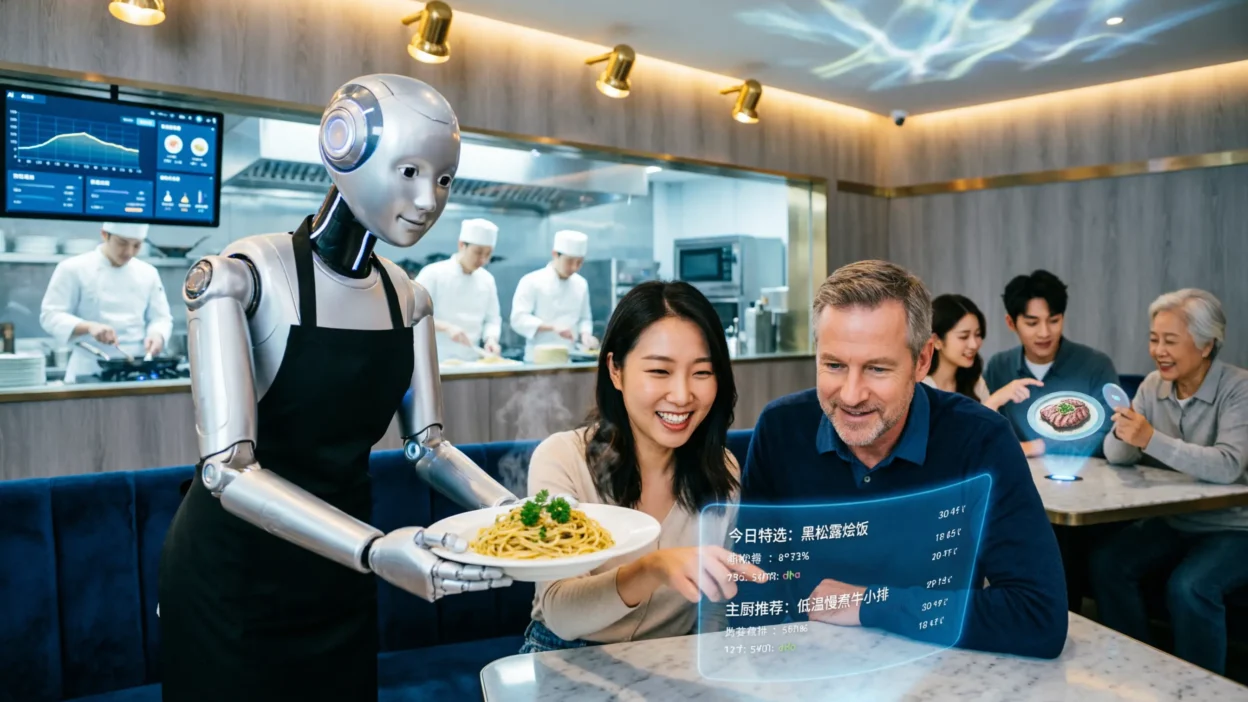
Restaurants have always evolved with technology. First came POS systems. Then online ordering. Now a new transformation is unfolding. AI in restaurants is reshaping how food businesses operate, serve guests, and manage costs.
Artificial intelligence no longer belongs only to tech companies. Restaurants now use AI restaurant technology to automate orders, forecast demand, manage inventory, personalize menus, and analyze customer behavior.
Why does this matter?
Because the restaurant industry runs on thin margins, unpredictable demand, and labor shortages. AI provides tools that help restaurants solve these challenges using data and automation.
According to industry reports, restaurants using artificial intelligence in restaurants operations can reduce food waste by up to 30%, improve forecasting accuracy by 20–40%, and increase order value through personalized recommendations.
In this guide you will learn:
- What restaurant AI actually is
- Real-world applications of AI for restaurants
- How AI improves customer experience and operations
- Benefits and challenges of adopting AI-powered restaurants
- Practical ways restaurants can start using AI today
Let’s explore how artificial intelligence is shaping the future of dining.
What Is AI in Restaurants?
AI in restaurants refers to the use of machine learning, predictive analytics, automation, and intelligent systems to improve restaurant operations and customer experiences.
Instead of relying on manual decisions, restaurants use AI-powered restaurant technology to analyze large datasets and make smart predictions.
These systems learn from historical patterns such as:
- Customer orders
- Peak hours
- Ingredient usage
- Menu performance
- Customer preferences
Over time the AI improves its predictions and recommendations.
At the core of restaurant automation, several technologies work together:
| Technology | Function in Restaurants |
| Machine learning | Predicts demand and customer behavior |
| Computer vision | Monitors kitchen safety and food preparation |
| Natural language processing | Powers chatbots and voice ordering |
| Predictive analytics | Forecasts inventory needs and sales |
| Voice recognition | Enables voice-activated ordering |
These systems power smart restaurant technology capable of handling both customer interactions and back-of-house operations.
Restaurants typically deploy AI in two main areas.
Front-of-House AI Systems
Front-of-house technology focuses on improving guest experience.
These systems support customer engagement, ordering, reservations, and marketing.
Examples include:
- AI phone answering systems
- AI agents for restaurants
- Voice-activated restaurant systems
- AI ordering kiosks
- AI-powered reservation systems
- AI loyalty programs
These tools support customer self-service and improve AI customer experience in restaurants.
For example, an AI phone assistant can answer calls, book tables, and take takeout orders. This reduces staff workload while ensuring customers receive quick responses.
Back-of-House AI Systems
Back-of-house technology focuses on operations.
These systems improve efficiency and reduce waste.
Examples include:
- AI inventory management for restaurants
- Restaurant staff scheduling AI
- AI food safety monitoring
- AI analytics for restaurants
- AI supply chain management in restaurants
Together these technologies create automated restaurant management systems that help owners make data-driven decisions.
Why Restaurants Are Adopting Artificial Intelligence Faster Than Ever
Several industry challenges have accelerated the adoption of AI in the food industry.
Restaurants face increasing pressure to operate more efficiently while delivering better experiences.
Here are the key factors driving adoption.
Rising Labor Costs
Labor is one of the largest expenses for restaurants.
In many markets labor costs now represent 30–35% of restaurant revenue.
AI helps reduce labor pressure by automating tasks such as:
- Order taking
- Call answering
- Staff scheduling
- Data analysis
Instead of replacing workers entirely, AI automation in restaurants allows staff to focus on hospitality.
Labor Shortages
The hospitality industry often struggles to fill roles.
AI systems provide support by handling repetitive tasks.
For example:
- AI bots answer customer questions
- Interactive Voice Response (IVR) systems handle phone orders
- Self-service kiosks reduce cashier demand
This allows restaurants to operate efficiently with smaller teams.
Higher Customer Expectations
Today’s diners expect fast service, personalized experiences, and digital convenience.
AI enables restaurants to deliver:
- AI-driven menu recommendations
- Personalized promotions
- Faster ordering
- Intelligent reservations
These capabilities create an AI-enhanced dining experience.
Growth of Digital Ordering
Online food ordering continues to grow rapidly.
Restaurants now process orders from:
- Mobile apps
- Delivery platforms
- Websites
- Phone orders
- In-store kiosks
Managing all these channels requires AI-powered customer insights and omnichannel interactions.
Key Use Cases of AI in Restaurants
The most powerful aspect of restaurant AI is its versatility.
AI systems can optimize nearly every aspect of restaurant operations.
Let’s examine the most important applications.
AI Ordering Systems and Self-Service Kiosks
One of the most visible forms of restaurant automation is AI ordering kiosks.
These machines allow customers to place orders without interacting with a cashier.
They use intelligent restaurant systems to:
- Display menus dynamically
- Suggest add-ons
- Customize orders
- Process payments
Benefits of AI Ordering Kiosks
- Faster ordering process
- Reduced staff workload
- Increased order accuracy
- Higher average order value
Research shows self-service kiosks can increase order size by 15–30% due to automated upselling.
Example features include:
- AI-driven menu recommendations
- Combo suggestions
- Dynamic promotions
These systems support restaurant digital transformation.
AI Phone Answering Systems for Restaurants
Restaurants often miss phone calls during busy hours.
Missed calls mean lost revenue.
This problem led to the development of AI phone answering systems.
These systems use AI voice assistants and conversational AI to answer calls automatically.
What AI Phone Agents Can Do
- Take takeout orders
- Book reservations
- Provide menu information
- Handle waitlists
- Answer common questions
This technology supports conversational commerce and conversational marketing for restaurants.
Example Workflow
- Customer calls restaurant
- AI assistant answers immediately
- Customer places order via voice
- Order is sent to kitchen system
This reduces call wait times and improves customer experience (CX).
AI Food Recommendations and Menu Personalization
AI also helps restaurants deliver personalized dining experiences.
These systems analyze:
- Customer order history
- Time of visit
- Dietary preferences
- Popular dishes
Using this data, AI generates AI food recommendations.
For example:
A regular customer who frequently orders vegetarian meals may see plant-based specials highlighted in the menu.
Benefits of AI Menu Personalization
- Higher customer satisfaction
- Increased order value
- Improved customer retention strategies
This type of customer personalization is common in large restaurant chains.
AI Inventory Management for Restaurants
Inventory mistakes cost restaurants thousands of dollars.
Restaurants often struggle with:
- Food spoilage
- Ingredient shortages
- Overstocking
AI inventory management for restaurants solves these problems.
These systems use predictive analytics to forecast ingredient usage.
Key Capabilities
- Real-time inventory tracking
- Automated purchase orders
- Ingredient shortage prediction
- AI supply chain optimization
Example workflow:
| Process | AI Action |
| Sales forecast | Predict ingredient demand |
| Inventory check | Compare stock levels |
| Supply planning | Generate purchase orders |
| Delivery scheduling | Optimize restocking |
Restaurants using AI inventory systems can reduce food waste by 20–30%.
AI Staff Scheduling and Workforce Forecasting
Staff scheduling is complex.
Restaurants must balance labor costs with customer demand.
Restaurant staff scheduling AI analyzes historical data to predict staffing needs.
It evaluates:
- Past sales
- Reservation trends
- Local events
- Seasonal demand
This supports AI workforce forecasting.
Benefits of AI Scheduling
- Optimized staffing levels
- Reduced overtime costs
- Improved employee satisfaction
- Faster schedule creation
Restaurants also improve their table turnover rate when staffing matches demand.
AI Analytics and Restaurant Business Intelligence
Data is one of the most valuable resources for restaurants.
AI transforms raw data into restaurant business intelligence.
These systems analyze operational metrics such as:
- Sales trends
- Menu performance
- Customer demographics
- Marketing results
Important Restaurant KPIs AI Can Track
| KPI | Purpose |
| Average order value | Measures revenue per order |
| Table turnover rate | Evaluates seating efficiency |
| Food cost percentage | Tracks profitability |
| Customer retention rate | Measures loyalty |
Using AI analytics for restaurants, owners gain operational data insights that support smarter decisions.
AI Dynamic Pricing in Restaurants
Dynamic pricing adjusts menu prices based on real-time demand.
Airlines and hotels have used this strategy for years.
Now restaurants are adopting AI dynamic pricing.
AI analyzes factors like:
- Demand levels
- Time of day
- Inventory availability
- Seasonal trends
Example Uses
- Happy hour pricing
- Limited-time offers
- Slow-hour discounts
This helps restaurants optimize revenue optimization.
AI Food Safety and Kitchen Monitoring
Food safety is critical in hospitality.
AI now supports food safety monitoring using sensors and computer vision.
These systems monitor:
- Food storage temperatures
- Cooking processes
- Kitchen sanitation
- Cross-contamination risks
Smart Kitchen Monitoring Example
| Sensor Type | Function |
| Temperature sensors | Monitor refrigerators |
| AI cameras | Detect hygiene violations |
| Smart alerts | Notify staff of risks |
This technology improves kitchen sanitation and reduces food safety violations.
AI-Powered Smart Kitchens
Modern kitchens are becoming increasingly automated.
Smart kitchen technology combines robotics, AI sensors, and automation.
Some restaurants now experiment with AI-powered chefs.
These robotic systems can:
- Cook burgers
- Fry food
- Assemble dishes
- Monitor cooking times
Benefits include:
- Consistent food quality
- Faster preparation
- Reduced human error
AI also assists with recipe recommendations and cooking optimization.
Benefits of AI in Restaurants
Restaurants adopting AI often experience improvements across operations, customer experience, and financial performance.
Operational Benefits
- Restaurant workflow automation
- Faster service speed
- Reduced food waste
- Accurate demand forecasting
- Better AI supply chain optimization
Customer Experience Benefits
- Personalized recommendations
- Faster ordering
- Smarter reservations
- Enhanced AI-powered hospitality services
These improvements increase customer engagement and satisfaction.
Business Benefits
AI also supports financial growth.
Benefits include:
- Improved profitability analysis
- Better cash flow prediction
- Data-driven restaurant pricing strategy
- Smarter financial forecasting
These insights help restaurants scale effectively.
Challenges and Risks of AI in Restaurants
Despite its advantages, AI adoption has challenges.
Restaurants must consider several factors before implementing AI systems.
Implementation Costs
Advanced AI tools require upfront investment.
Costs may include:
- Hardware
- Software subscriptions
- Staff training
However many AI tools now offer affordable cloud-based solutions.
Staff Training
Employees must learn how to work with AI systems.
Restaurants should provide training for:
- POS integration
- data analysis
- AI tools
This ensures smooth adoption.
Data Privacy
AI systems collect customer data.
Restaurants must handle data responsibly to protect privacy.
Key practices include:
- secure storage
- compliance with data regulations
- transparency with customers
Over-Automation Risks
Hospitality still relies on human interaction.
Restaurants should balance automation with genuine service.
AI should support staff rather than replace hospitality.
Real Examples of Restaurants Using AI
Many brands already use AI-powered restaurants technology.
Here are notable examples.
Toast
Toast provides restaurant software with AI analytics, POS systems, and operational insights.
Restaurants use Toast to track sales, analyze data, and optimize operations.
Restaurant365
Restaurant365 focuses on AI financial management for restaurants.
It helps restaurants manage:
- accounting
- payroll
- inventory
- forecasting
Raydiant
Raydiant specializes in customer experience platforms for restaurants.
Their systems support digital signage and AI-driven engagement.
Grill’d
Grill’d has experimented with AI ordering and digital restaurant experiences.
These technologies help streamline customer interactions.
Best AI Tools for Restaurants
Here are some widely used AI tools in the restaurant industry.
| Tool | Purpose | Key Feature |
| Toast | POS and analytics | Restaurant data insights |
| Zendesk AI | Customer service | AI chatbots and call automation |
| Restaurant365 | Financial management | Accounting automation |
| Raydiant | Customer experience | Smart digital signage |
These tools support restaurant technology innovation.
How Restaurants Can Start Using AI
Adopting AI does not require a full technological overhaul.
Restaurants can begin gradually.
Identify Operational Bottlenecks
Start by identifying areas where AI can provide the most value.
Common problems include:
- missed calls
- inventory waste
- slow ordering processes
Start with High-ROI AI Tools
Restaurants often begin with tools such as:
- AI phone systems
- AI inventory software
- automated ordering kiosks
These provide quick returns on investment.
Integrate AI with Existing Systems
AI works best when integrated with:
- POS systems
- reservation software
- customer databases
This enables full restaurant operational efficiency.
Train Staff
Employees should understand how AI tools support their work.
Training ensures the technology improves productivity.
Monitor Performance Metrics
Track key metrics such as:
- order accuracy
- labor costs
- customer satisfaction
These metrics reveal whether AI is delivering results.
The Future of AI in Restaurants
AI technology continues to evolve rapidly.
Future restaurants may rely heavily on automation and intelligent systems.
Expected developments include:
- fully automated kitchens
- advanced AI-powered chefs
- predictive dining experiences
- smarter AI-powered reservation systems
- fully integrated AI-driven marketing for restaurants
Restaurants will increasingly rely on data-driven decision making to remain competitive.
One thing remains clear.
AI will not replace hospitality.
Instead it will empower restaurants to deliver faster service, personalized experiences, and more efficient operations.
FAQs About AI in Restaurants
What is AI in restaurants?
AI in restaurants refers to the use of artificial intelligence technologies such as machine learning, predictive analytics, and automation to improve restaurant operations, customer service, and business decisions.
How do restaurants use artificial intelligence?
Restaurants use AI for:
- ordering systems
- inventory management
- customer analytics
- staff scheduling
- marketing automation
These tools improve efficiency and customer experience.
What are the benefits of AI for restaurants?
Major benefits include:
- faster service
- reduced food waste
- better forecasting
- improved customer personalization
- higher revenue
Can AI replace restaurant staff?
AI does not replace staff entirely.
Instead it automates repetitive tasks so employees can focus on hospitality and customer service.
What are the best AI tools for restaurants?
Popular tools include:
- Toast
- Zendesk AI
- Restaurant365
- Raydiant
These platforms help restaurants manage operations and customer experiences.
Conclusion
The rise of AI in restaurants marks one of the most important shifts in hospitality technology.
From AI ordering kiosks to predictive analytics and smart kitchens, artificial intelligence is transforming how restaurants operate.
Restaurants that adopt AI restaurant management tools gain powerful advantages:
- improved operational efficiency
- enhanced customer experiences
- smarter decision-making
- higher profitability
As AI-powered restaurants continue to grow, one thing becomes clear.
The future of dining will combine human hospitality with intelligent technology.

Joan Didion is a passionate writer at DreamMaening.com, exploring the hidden meanings behind dreams, symbols, and life’s mysteries with clarity and insight.