
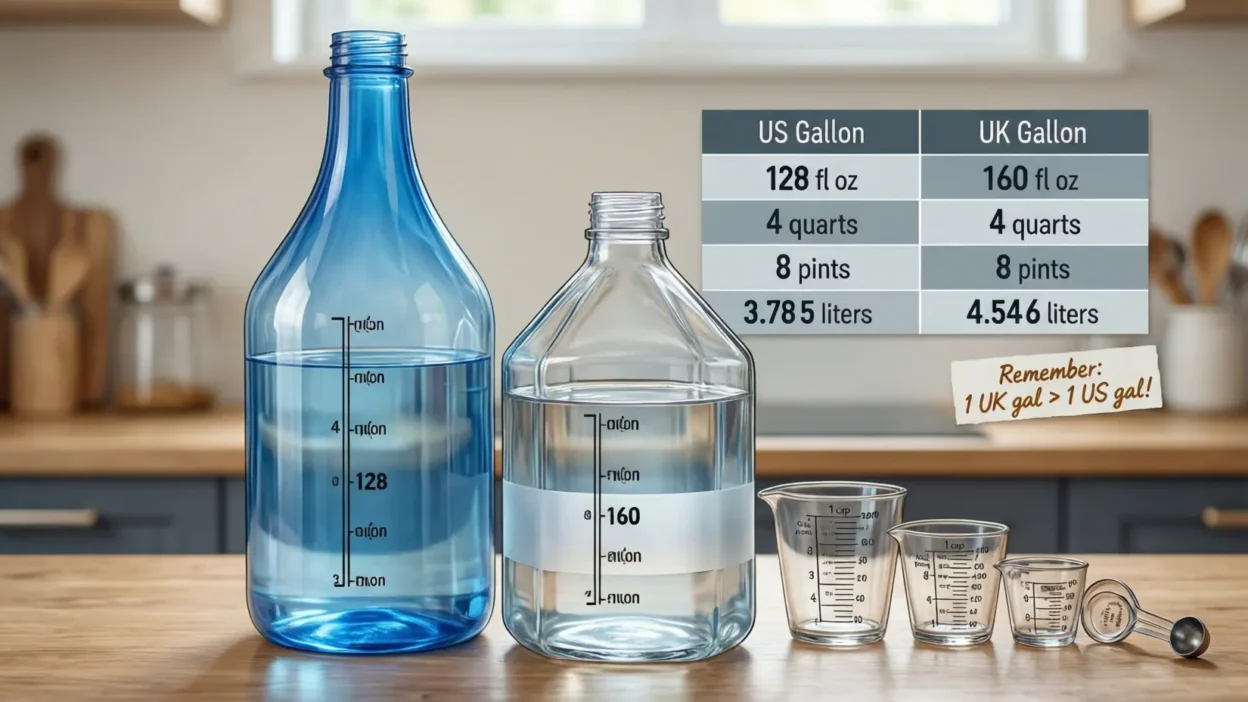
Have you ever stood in the kitchen trying to follow a recipe or measured liquids for a project and wondered, “How many ounces are in a gallon?” You’re not alone. Whether you’re baking, making cocktails, filling a container, or even working on a science experiment, understanding gallon-to-ounce conversions is essential. Many people get confused because there are different types of gallons US gallons and UK (Imperial) gallons and the number of ounces in each isn’t the same.
In this guide, we’ll break down everything you need to know about ounces and gallons, explain the differences between measurement systems, and provide easy-to-follow charts and examples. By the end, you’ll have a clear, foolproof method to convert gallons to ounces quickly and accurately no more guessing or mistakes. Let’s dive in and simplify these measurements once and for all.
Understanding Gallons and Ounces
Before we dive into the conversions, it’s important to understand exactly what gallons and ounces are and why they can be confusing. A gallon is a unit of volume used to measure liquids, but it isn’t the same everywhere. In the United States, a gallon equals 128 US fluid ounces, while in the United Kingdom, an Imperial gallon is 160 UK fluid ounces. That’s a big difference, especially if you’re following a recipe from another country!
On the other hand, an ounce is a smaller unit of measurement, often used in cooking, beverages, and science. It can measure fluid ounces (volume) or ounces by weight (mass), and mixing the two can create confusion. For liquids, we focus on fluid ounces, which tells us how much space a liquid occupies.
Understanding these differences is essential because accurate measurements can affect the outcome of your recipe, experiment, or project. For example, pouring 128 US ounces of milk into a UK gallon container won’t fill it completely it would leave space because the UK gallon is larger.
To make things easier, we’ll also cover how gallons relate to quarts, pints, and cups, so you can quickly calculate ounces without memorizing complicated formulas. With this foundation, converting gallons to ounces becomes simple, accurate, and stress-free.
How Many Ounces in a Gallon
So, how many ounces are actually in a gallon? The answer depends on whether you are using the US system or the UK (Imperial) system. In the United States, one gallon equals 128 US fluid ounces. Meanwhile, in the United Kingdom, one gallon equals 160 UK fluid ounces. This difference can easily confuse anyone following recipes or measuring liquids from different sources.
Here’s a simple way to remember:
| Measurement | US System | UK System |
| 1 gallon | 128 oz | 160 oz |
| 1 quart | 32 oz | 40 oz |
| 1 pint | 16 oz | 20 oz |
| 1 cup | 8 oz | 10 oz |
Example 1: If a recipe calls for 1 gallon of milk in the US, you’ll need 128 US fluid ounces. If you tried to use a UK gallon instead, you’d actually pour 160 ounces, which could affect your recipe’s outcome.
Example 2: For a half-gallon of water, simply divide by 2: 64 US ounces or 80 UK ounces.
Knowing the exact number of ounces in a gallon is not only useful for cooking, but also for mixing drinks, gardening, or science experiments. With this simple table and examples, you can confidently measure liquids and avoid mistakes, no matter which system you’re using.
US vs UK Gallon Differences Explained
One of the most confusing parts of measuring liquids is the difference between US gallons and UK (Imperial) gallons. Although both are called “gallons,” they are not equal. The US gallon is smaller, measuring 128 US fluid ounces, while the UK gallon is larger, containing 160 UK fluid ounces. This difference exists because the two countries historically used different systems of measurement.
The US system is based on the Queen Anne wine gallon from the 18th century, which was later standardized in the United States. The UK Imperial gallon, on the other hand, was defined in 1824 as exactly 4.54609 liters, making it larger than the US version.
Why does this matter today? If you follow a recipe, pour fuel, or measure liquids using the wrong gallon, you could end up with too much or too little. For example:
- Filling a UK gallon container with 128 US ounces leaves space it won’t be full.
- Using UK recipes in the US without converting gallons to ounces can alter cooking results or chemical mixtures.
To make life easier, always check which system is being used. Many recipes and instructions now include fluid ounces, making it simpler to measure accurately. By understanding this key difference, you can avoid mistakes and confidently convert between gallons and ounces whenever needed.
Practical Uses of Gallon-to-Ounce Conversion
Knowing how many ounces are in a gallon isn’t just a math exercise it’s incredibly useful in everyday life. From cooking to science projects, understanding this conversion can save you time, prevent mistakes, and make tasks much easier.
1. Cooking and Baking: Many recipes list ingredients in fluid ounces, while others use gallons. For example, if a punch recipe calls for 1 gallon of juice, you’ll know to measure out 128 US ounces (or 160 UK ounces if it’s a UK recipe). Accurate measurements ensure your dish or drink turns out perfectly every time.
2. Beverages and Mixology: Bartenders often work with ounces, while some cocktail recipes reference gallons for larger batches. Converting gallons to ounces helps you scale drinks accurately for parties or events.
3. Home Projects: From painting walls to mixing cleaning solutions, gallons are a common measurement. Converting to ounces helps measure smaller quantities more precisely, avoiding waste or uneven mixtures.
4. Science Experiments and Labs: Experiments often require precise liquid measurements. Knowing the exact number of ounces in a gallon ensures accurate results and consistency in experiments.
5. Gardening and Agriculture: Watering plants or mixing fertilizers often involves gallons. Using ounces allows for precise application, especially for small pots or delicate plants.
By understanding gallon-to-ounce conversions, you can handle any liquid measurement confidently, no matter the context. It saves time, reduces errors, and ensures accuracy in cooking, DIY projects, experiments, and more.
Easy Ways to Remember the Conversion
If you struggle to remember how many ounces are in a gallon, don’t worry you’re not alone. The good news is, there are simple tricks and mnemonics to make it easy.
1. Focus on the US gallon first: One US gallon is 128 ounces. A helpful trick is to break it down into smaller parts:
- 1 gallon = 4 quarts → 1 quart = 32 ounces
- 1 gallon = 8 pints → 1 pint = 16 ounces
- 1 gallon = 16 cups → 1 cup = 8 ounces
By memorizing just the smaller units, you can reconstruct the total ounces in a gallon quickly.
2. Use multiplication or division: Once you know 1 gallon = 128 ounces, you can easily calculate halves, doubles, or fractions. For example:
- Half a gallon = 128 ÷ 2 = 64 ounces
- Two gallons = 128 × 2 = 256 ounces
3. Visual aids: Imagine a gallon jug in front of you. Split it mentally into 4 equal quarts or 16 cups. Associating ounces with physical containers makes conversions more intuitive.
4. Remember the UK difference: If you ever deal with a UK recipe, remember that an Imperial gallon is 160 ounces slightly bigger than a US gallon. A quick mental check ensures you don’t accidentally overpour.
5. Create a simple rhyme or phrase: Something like, “US gallon’s one-two-eight, UK’s bigger at one-six-zero-eight.” Short, catchy, and surprisingly easy to recall.
With these tips, converting gallons to ounces becomes fast, accurate, and stress-free, whether you’re cooking, experimenting, or mixing drinks.
Common Mistakes and How to Avoid Them
Even experienced cooks, bartenders, and DIY enthusiasts sometimes make mistakes when converting gallons to ounces. Being aware of these pitfalls can save you frustration and wasted ingredients.
1. Confusing US and UK gallons: One of the most frequent errors is assuming a gallon is the same everywhere. Remember, a US gallon is 128 ounces, while a UK gallon is 160 ounces. Using the wrong system can lead to overpouring or underpouring, which can ruin a recipe or project.
2. Mixing fluid ounces with weight ounces: A fluid ounce measures volume, while an ounce by weight measures mass. For example, 8 ounces of water equals 1 cup, but 8 ounces of flour is not the same volume as 1 cup. Always check whether the measurement refers to fluid ounces.
3. Forgetting smaller unit conversions: Some people skip converting gallons into quarts, pints, or cups before calculating ounces, leading to errors. Breaking it into smaller, familiar units helps prevent mistakes.
4. Miscalculating multiples: When working with half-gallons, double gallons, or fractions, it’s easy to miscalculate if you don’t multiply or divide carefully. Always do the math step by step: 1 gallon = 128 ounces, so half = 64 ounces, two gallons = 256 ounces.
5. Relying on memory alone: Even if you think you remember, checking a conversion chart or table ensures accuracy. It’s better to double-check than to guess.
By keeping these common mistakes in mind and following simple tips, you can measure liquids confidently, accurately, and efficiently in any situation.
FAQs
To make your life even easier, here are answers to some of the most common questions about gallons and ounces.
1. How many ounces are in half a gallon?
A half-gallon is simply half of a full gallon. In the US system, that’s 64 ounces, and in the UK system, it’s 80 ounces.
2. How many ounces are in 2 gallons?
Doubling the gallon is easy. Two US gallons equal 256 ounces, while two UK gallons equal 320 ounces.
3. Is a gallon the same in all countries?
No. The US gallon is 128 fluid ounces, while the UK (Imperial) gallon is 160 fluid ounces. Always check which system your recipe or project uses.
4. Can I use cups instead of ounces in a gallon conversion?
Yes. 1 US gallon = 16 cups (8 ounces per cup), and 1 UK gallon = 16 cups as well, but each cup in the UK system is 10 ounces. Knowing this helps when measuring smaller quantities.
5. What’s the difference between fluid ounces and ounces by weight?
Fluid ounces measure volume (space a liquid occupies), while ounces by weight measure mass (how heavy something is). For liquids, always use fluid ounces.
6. How do I quickly convert gallons to ounces?
Use a simple formula:
- US gallons → ounces = gallons × 128
- UK gallons → ounces = gallons × 160
These FAQs cover the most common questions and make it easy for anyone to convert gallons to ounces accurately. Bookmark this guide for quick reference!
Conclusion
Understanding how many ounces are in a gallon is simpler than it seems once you know the key differences and conversion methods.
The most important thing to remember is that a US gallon equals 128 fluid ounces, while a UK (Imperial) gallon equals 160 fluid ounces. Confusing the two can lead to mistakes in cooking, DIY projects, beverages, or scientific experiments.
Breaking a gallon down into smaller units quarts, pints, and cups makes the math easy. For example, 1 gallon = 4 quarts = 8 pints = 16 cups. Using these conversions, you can calculate half-gallons, double gallons, or any fraction without guesswork. Additionally, distinguishing between fluid ounces and weight ounces is essential, especially in recipes and lab measurements.
We also covered practical tips, memory tricks, and common mistakes to avoid, helping you measure liquids accurately every time. From kitchen recipes and cocktails to gardening, painting, or experiments, knowing your ounces per gallon ensures consistency and success in any task.
To make things even easier, keep a conversion chart handy or bookmark this guide. With these simple strategies, you can confidently handle gallons and ounces in any situation, whether US or UK measurements. No more second-guessing, no more errors just accurate, easy conversions every time.
By following this guide, you’ll never struggle with gallons and ounces again. Save it, refer to it, and make your liquid measurements stress-free!

Jon Krakauer is a renowned American author and journalist, best known for his insightful storytelling and deep exploration of the human experience. On Dreammaening.com, Jon brings his thoughtful voice and investigative curiosity into the mysterious world of dreams, spirituality, and symbolism. His writing invites readers to look beyond the surface of their nightly visions and discover the hidden meanings that connect the subconscious mind with everyday life.