
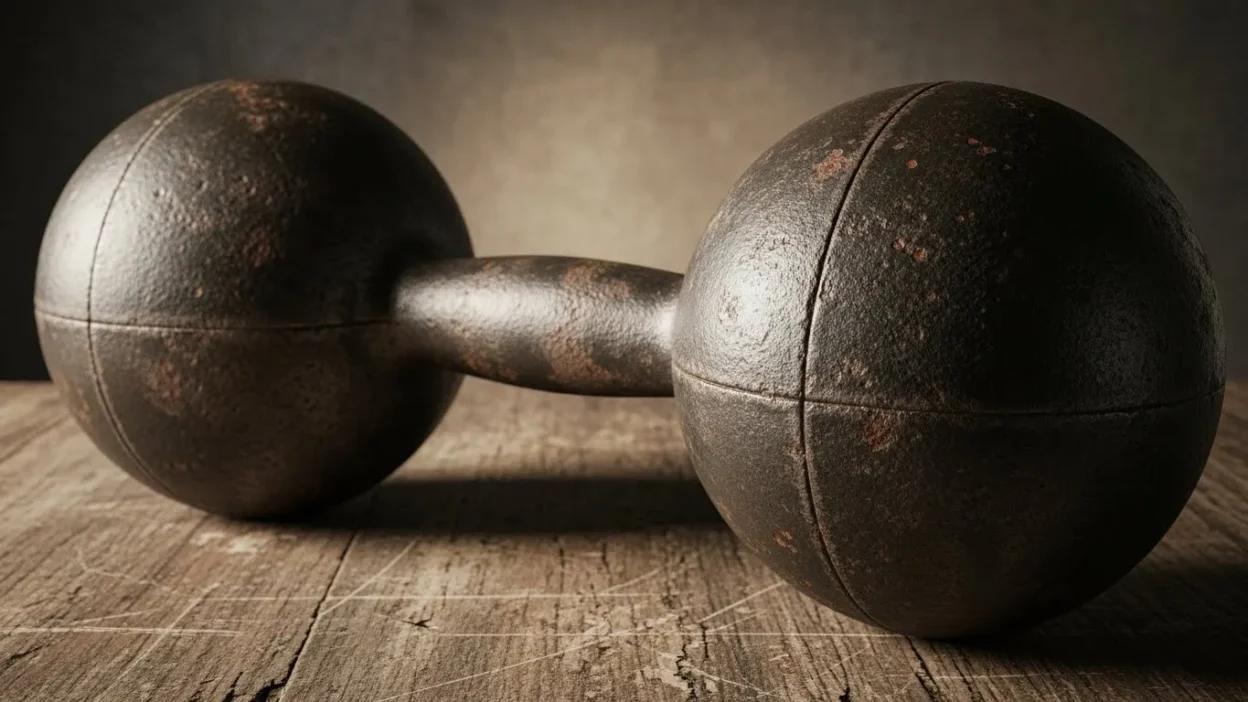
The Thomas Inch dumbbell is one of the most legendary and misunderstood strength challenges in history.
At first glance, it looks like an ordinary heavy dumbbell something a strong gym-goer should be able to lift without much trouble.
But once you try to pick it up, reality sets in fast. Despite weighing around 172 pounds (78 kg), the Thomas Inch dumbbell has humbled elite strongmen, powerlifters, and grip athletes for decades.
What makes this dumbbell truly unique isn’t just its weight, but its thick, non-rotating handle and perfectly balanced cast-iron design.
Unlike modern dumbbells, it cannot be adjusted, spun, or “cheated” off the floor. It demands pure grip strength, hand control, and technique all in one hand.
In this article, we’ll break down the exact weight, explain why it’s so hard to lift, explore its history, and reveal why the Thomas Inch dumbbell remains the ultimate test of grip strength today.
What Is the Thomas Inch Dumbbell?
The Thomas Inch dumbbell is a legendary piece of strength equipment created in the early 20th century by British strongman Thomas Inch, also known as “The Strongest Man in Britain.” Unlike modern adjustable dumbbells found in gyms today, the Inch dumbbell is a solid, one-piece cast iron dumbbell with a fixed weight and a thick handle. There are no plates, collars, or rotating parts—what you see is exactly what you have to lift.
What makes the Thomas Inch dumbbell unique is its purpose. It was not designed for regular training or repetition work. Instead, it was created as a challenge object, meant to test true grip strength and one-hand lifting ability. The dumbbell quickly became famous because Thomas Inch would challenge other strongmen and athletes to lift it with one hand—and most failed.
Visually, the dumbbell is deceptive. It looks similar in size to a heavy but manageable dumbbell, leading many people to underestimate it. However, the thick handle and smooth iron surface make gripping it extremely difficult. Since the handle does not rotate, all the force must be controlled directly through the hand and forearm, without any mechanical advantage.
Over time, the Thomas Inch dumbbell has become a gold standard in grip strength. Successfully lifting it is considered a major achievement in the strength world, placing it in the same category as historic feats like bending steel bars or lifting legendary stones.
Thomas Inch Dumbbell Weight (Exact Measurements)
One of the most common questions people ask is: how heavy is the Thomas Inch dumbbell? The official and widely accepted weight of the original Thomas Inch dumbbell is approximately 172 pounds, which equals about 78 kilograms. On paper, this weight may not seem impossible, especially for experienced lifters who regularly handle heavy dumbbells or barbells. However, the real challenge lies far beyond the number itself.
Unlike adjustable dumbbells, the Thomas Inch dumbbell is a fixed-weight, solid cast-iron implement. This means the weight is perfectly balanced but completely unforgiving. There is no opportunity to adjust hand placement or rely on spinning sleeves to reduce strain on the grip. Every pound of that 172-pound load must be controlled entirely by one hand.
To put this into perspective, many gym dumbbells that weigh 150–200 pounds have thin, rotating handles, making them far easier to hold. In contrast, the Inch dumbbell’s weight feels significantly heavier because the grip is the limiting factor, not overall body strength.
Another important detail is that slight variations exist in modern replicas, with some weighing a few pounds more or less. However, even replicas close to the original 78 kg weight remain brutally difficult. This explains why the Thomas Inch dumbbell continues to be one of the most respected tests of pure grip strength in the strength training world.
Handle Thickness and the Grip Challenge Explained
The true difficulty of the Thomas Inch dumbbell lies in its handle thickness, which dramatically changes how the weight is experienced. The handle measures roughly 2.38 inches (about 60 mm) in diameter, far thicker than the standard dumbbell handles found in most gyms. Typical dumbbells have handles around 1 inch thick, allowing the fingers and thumb to wrap fully around the bar. With the Inch dumbbell, this is nearly impossible for most hands.
Because the handle is so thick, the lifter cannot create a strong “closed grip.” Instead of squeezing the handle firmly, the hand is forced into a more open position, reducing leverage and limiting the amount of force that can be applied. This puts extreme stress on the thumb, fingers, and supporting grip muscles of the forearm.
Another critical factor is that the handle does not rotate. Modern dumbbells often spin slightly, helping distribute the load more comfortably across the hand. The Thomas Inch dumbbell offers no such assistance. Any small imbalance immediately pulls the dumbbell out of the lifter’s hand, making control incredibly difficult from the moment it leaves the ground.
Additionally, the smooth iron surface provides minimal friction, increasing the risk of the dumbbell slipping. This combination of thick handle, non-rotating design, and low friction is why even athletes with impressive deadlift or bench press numbers often fail to lift it. In short, the Inch dumbbell is less a test of overall strength and more a brutal examination of true, unassisted grip power.
Why the Thomas Inch Dumbbell Is So Difficult to Lift
The Thomas Inch dumbbell is difficult not because of a single factor, but because several challenging elements combine into one unforgiving lift. First, the dumbbell is designed to be lifted with one hand only, instantly doubling the demand placed on the grip and forearm compared to two-handed lifts. Even very strong athletes often lack the one-hand control needed to stabilize such a heavy object.
Another major factor is the perfectly balanced weight distribution. While balance might sound helpful, it actually works against the lifter. There is no uneven loading to “cheat” the lift by shifting the dumbbell into a more favorable position. The moment it leaves the floor, the entire 172-pound load must be controlled directly through the hand.
The dumbbell’s solid cast construction also eliminates any flex or movement. Unlike barbells or adjustable dumbbells that allow slight adjustments mid-lift, the Inch dumbbell offers no margin for error. A minor grip slip or wrist deviation is enough to cause immediate failure.
Hand size also plays a role. Lifters with smaller hands struggle to generate enough thumb pressure around the thick handle, while even those with large hands must rely on exceptional grip strength. Finally, the psychological challenge cannot be ignored. Many lifters approach the dumbbell expecting success, only to be shocked when it barely leaves the ground. This combination of physical and mental difficulty is what makes the Thomas Inch dumbbell such a legendary and respected feat of strength.
Who Was Thomas Inch? (History and Background)
To fully appreciate the Thomas Inch dumbbell, it’s important to understand the man behind it. Thomas Inch was a British strongman born in the late 19th century and was widely known during his time as “The Strongest Man in Britain.” He performed across the United Kingdom and Europe, showcasing extraordinary feats of strength that helped define the golden era of old-time strongmen.
Thomas Inch was especially famous for his one-hand lifting ability, a skill that set him apart from many of his contemporaries. To prove his strength and challenge others, he commissioned the creation of a unique dumbbell that would be nearly impossible for anyone else to lift. This dumbbell later became known simply as the Inch Dumbbell.
Inch would often invite other strongmen, athletes, and even skeptical spectators to attempt lifting it. Most failed, which only added to his reputation and the dumbbell’s legendary status. The challenge became a powerful marketing tool during a time when strongmen relied on public demonstrations to build fame.
What makes Thomas Inch’s legacy remarkable is that his dumbbell outlived his performances. Long after his career ended, the Thomas Inch dumbbell continued to be used as a benchmark of elite grip strength. Today, it remains one of the most iconic symbols of old-school strength culture, connecting modern lifters to the roots of strength sports.
Who Has Lifted the Thomas Inch Dumbbell?
Very few people in history have successfully lifted the Thomas Inch dumbbell, which is why the feat carries so much prestige in the strength community. Despite weighing “only” around 172 pounds (78 kg), the dumbbell has defeated countless strongmen, powerlifters, and bodybuilders who were otherwise capable of lifting far heavier weights with barbells or standard dumbbells.
Among those who have lifted it are elite grip strength specialists and strongmen with exceptional hand power. These athletes typically train extensively with thick bars, axle lifts, and specialized grip equipment. Their success is not accidental—it is the result of years of focused grip development rather than general strength training alone.
What makes lifting the Inch dumbbell especially impressive is that the lift must be performed cleanly with one hand, without using the other hand, legs, or body to assist. Even pulling it a few inches off the ground is considered a respectable effort by experienced lifters.
Many famous strength athletes have publicly attempted the lift and failed, which has only increased its reputation. This rarity is part of what keeps the Thomas Inch dumbbell relevant today. Successfully lifting it places an athlete in a very small and respected group, symbolizing mastery over one of the most demanding grip challenges ever created.
Thomas Inch Dumbbell vs Regular Dumbbells
When compared to regular gym dumbbells, the Thomas Inch dumbbell highlights just how misleading appearances can be. At a glance, it looks similar in size to a heavy commercial dumbbell—something that many strong lifters believe they can handle. However, the lifting experience is completely different.
Standard dumbbells are designed for comfort and efficiency. They typically have thin, knurled, rotating handles that allow the hands to wrap fully around the grip. This design reduces strain on the fingers and lets the handle rotate slightly during the lift, making heavy weights far more manageable. In contrast, the Thomas Inch dumbbell has a thick, smooth, non-rotating handle that offers no assistance at all.
Another key difference is how the weight is used. Regular dumbbells are commonly lifted with two hands or used in controlled movements like presses and rows. The Inch dumbbell, however, is a one-hand lift from the floor, requiring the lifter to overcome gravity, balance, and grip failure all at once.
Perhaps the most striking difference is perception versus reality. Many lifters who can easily curl or press 100-pound dumbbells struggle to even break the Inch dumbbell off the ground. This comparison clearly shows that grip strength, not overall muscular size or barbell numbers, is the deciding factor. That’s why the Thomas Inch dumbbell remains a unique and respected challenge that standard gym equipment simply cannot replicate.
Can an Average Gym-Goer Lift the Thomas Inch Dumbbell?
For most gym-goers, lifting the Thomas Inch dumbbell is a nearly impossible task. While a standard dumbbell of similar weight might be manageable for someone who regularly trains with heavy weights, the Inch dumbbell is a completely different challenge. Its thick, smooth, non-rotating handle demands extraordinary grip strength, something that most casual lifters have not developed.
Even individuals who can deadlift or bench press hundreds of pounds often fail when attempting the Inch dumbbell. This is because grip, not overall strength, is the limiting factor. The dumbbell requires precise hand placement, forearm strength, and wrist stability, all in one hand. Without years of specific training, the dumbbell will simply roll or slip out of the lifter’s grasp.
Hand size also plays a role. Lifters with smaller hands struggle to wrap their fingers fully around the thick handle, making it almost impossible to generate the required leverage. Those with larger hands may have a better chance, but success still depends on specialized grip training.
For the average gym-goer, attempting the Thomas Inch dumbbell is more about respecting the challenge than lifting it successfully. It serves as a reminder that certain feats of strength require dedicated training, technique, and grip development—qualities that go beyond typical gym routines.
Training Methods to Prepare for the Thomas Inch Dumbbell
Successfully lifting the Thomas Inch dumbbell requires more than general strength—it demands specialized grip and hand training. Lifters aiming to conquer this legendary dumbbell must focus on exercises that mimic its unique challenges, particularly thick-handle lifts and one-hand control.
One of the most effective methods is thick bar or fat grip training. Tools like fat gripz or thick-handled dumbbells increase the diameter of the grip, forcing the hands and forearms to work harder. Exercises such as axle deadlifts, farmer’s carries, and one-hand holds strengthen the specific muscles needed to control the Inch dumbbell.
Another key area is grip strength. Techniques like Rolling Thunder lifts, pinch grips, and plate pinches target the crushing and supporting grip required to hold the dumbbell steadily. Wrist curls and reverse wrist curls also help develop forearm endurance, which prevents early failure during the lift.
Hand positioning and technique are equally important. Practicing the clean lift with progressively heavier thick-handled implements teaches coordination, balance, and confidence, all crucial for Inch dumbbell attempts.
While overall strength is beneficial, the secret to lifting the Thomas Inch dumbbell lies in grip mastery, hand endurance, and technique. Dedicated, progressive training over months or years is usually necessary to succeed, emphasizing why so few athletes ever manage to lift this iconic challenge.
Modern Replicas of the Thomas Inch Dumbbell
Because the original Thomas Inch dumbbell is rare and historic, many strength enthusiasts turn to modern replicas to experience its challenge. These replicas are designed to closely mimic the original’s weight, handle thickness, and one-hand lift difficulty, allowing lifters to test their grip strength without needing access to the antique piece.
Most replicas weigh approximately 172 pounds (78 kg), just like the original. The handle diameter is also carefully matched to the original ~2.38 inches, which maintains the same grip challenge. Some replicas even use solid cast iron to replicate the feel and smoothness of the original, while others may feature slightly textured handles for safety or practicality.
Despite attempts at accuracy, small differences exist. Some replicas are marginally heavier or lighter, and the finish may vary. For example, newer replicas often have a more polished or coated surface, which can slightly improve grip friction compared to the original’s smooth iron.
These replicas are popular among grip strength competitors, strongman athletes, and serious enthusiasts who want to experience the challenge safely. While lifting a replica doesn’t carry the same historic prestige, it provides invaluable practice and helps lifters understand the unique demands of the Thomas Inch dumbbell. For many, replicas serve as both a training tool and a symbol of respect for one of strength sports’ most legendary feats.
Myths and Misconceptions About the Thomas Inch Dumbbell
The Thomas Inch dumbbell has been surrounded by myths and misconceptions for over a century. Many people assume that because it weighs “only” 172 pounds (78 kg), it should be liftable by any strong athlete. In reality, the dumbbell’s difficulty lies entirely in grip and technique, not overall muscular strength. Even lifters who can deadlift 500 pounds with ease often fail to lift it with one hand.
Another common misconception is that only extremely large hands can succeed. While hand size can help, success depends far more on grip strength, forearm endurance, and one-hand coordination. Small-handed athletes with dedicated grip training can lift it, while large-handed lifters without proper training often cannot.
Some also believe that modern gym strength directly translates to Inch dumbbell success. Standard weightlifting often emphasizes two-handed lifts, machine exercises, or barbell movements, which do not develop the crushing and supporting grip required for the dumbbell. The Inch dumbbell demands raw, unassisted grip strength, making it a completely different skill.
Lastly, there’s the myth that replicas are easier than the original. While small differences exist, replicas maintain the essential challenges: thick handle, non-rotating design, and smooth surface. This means the difficulty remains extremely high, ensuring the Thomas Inch dumbbell—original or replica—remains one of the ultimate tests of grip strength today.
Why the Thomas Inch Dumbbell Remains a Gold Standard of Grip Strength
The Thomas Inch dumbbell has stood the test of time, not just as a piece of equipment but as a symbol of ultimate grip strength. Even more than a century after its creation, it remains a benchmark for strongmen, grip athletes, and strength enthusiasts worldwide. What makes it unique is that it tests pure one-hand grip, something that few other lifts can measure accurately.
Unlike standard weightlifting exercises that rely on multiple muscle groups or two-handed lifts, the Inch dumbbell isolates the forearm, fingers, and thumb, forcing the lifter to rely entirely on grip power. Successfully lifting it demonstrates a combination of hand strength, technique, and mental focus—traits that are highly respected in the strength community.
Its legendary status is also reinforced by history. The original dumbbell was designed by Thomas Inch as a challenge, and for decades, it defeated nearly every strongman who attempted it. Even today, athletes train specifically to lift it, often sharing videos online or using replicas to gauge progress.
The dumbbell’s continued relevance also comes from the fact that it cannot be “cheated.” No rotating handles, no adjustable plates, no leverage tricks—just raw, unassisted grip strength. This makes it a true test of hand power and an enduring icon in the world of strength sports. For anyone serious about grip training, the Thomas Inch dumbbell represents the pinnacle of achievement and a timeless challenge that separates the average from the elite.
Frequently Asked Questions (FAQ) About the Thomas Inch Dumbbell
The Thomas Inch dumbbell has fascinated strength enthusiasts for over a century, and naturally, it raises many questions. Addressing these common queries helps clarify why this legendary dumbbell remains so challenging.
1. How much does the Thomas Inch dumbbell weigh exactly?
The original Thomas Inch dumbbell weighs approximately 172 pounds (78 kilograms). While the number itself might not seem extreme, the dumbbell’s design makes it exceptionally difficult to lift.
2. Why is it harder than it looks?
The combination of a thick, smooth handle, one-hand lifting requirement, and non-rotating design makes the dumbbell far more challenging than standard gym weights. Grip strength, not overall muscular strength, is the limiting factor.
3. Can anyone lift it with training?
Yes, but only with specialized grip training over months or years. Exercises like thick bar lifts, Rolling Thunder, pinch grips, and one-hand deadlifts help build the necessary hand and forearm strength.
4. Who has lifted the Thomas Inch dumbbell?
Very few elite grip athletes and strongmen have successfully lifted it. Even experienced lifters often fail on the first attempt.
5. Are replicas easier to lift than the original?
Most modern replicas are very close in weight and handle thickness to the original. While some replicas may offer slightly better grip friction, the challenge remains extremely difficult.
6. Is it still relevant today?
Absolutely. The Thomas Inch dumbbell is considered a gold standard of grip strength, and lifting it—even a replica—is a respected achievement in the strength community.
These FAQs not only answer common curiosities but also highlight why the Thomas Inch dumbbell continues to captivate lifters worldwide.
Conclusion
The Thomas Inch dumbbell is far more than just a heavy piece of iron—it is a legendary test of grip strength, technique, and mental focus. Weighing approximately 172 pounds (78 kilograms) and featuring a thick, non-rotating handle, it challenges even the strongest athletes in ways that standard dumbbells and barbells simply cannot. Its difficulty comes not from overall body strength, but from the grip, forearm endurance, and precision required to control it with one hand.
Created by British strongman Thomas Inch over a century ago, the dumbbell has become an enduring symbol of old-time strength and a benchmark for modern grip athletes. Very few people in history have successfully lifted it, and even today, it remains a rare achievement that commands respect in the strength community. Replicas allow enthusiasts to experience the challenge, but the core test—handling a thick, smooth, and unforgiving handle—remains the same.
Ultimately, the Thomas Inch dumbbell stands as a gold standard in strength sports, reminding us that true power isn’t just about lifting heavy weights—it’s about mastering the subtleties of control, grip, and perseverance. For anyone passionate about strength training or grip development, it remains an iconic challenge and a timeless testament to human capability.

Ta-Nehisi Coates is a celebrated American author and journalist, renowned for his deep insights into culture, history, and the human experience. At Dreammaening.com, he brings his thoughtful perspective to the world of dreams, symbolism, and spiritual meaning, helping readers uncover the deeper messages behind their nighttime visions. With a distinctive voice that blends storytelling, research, and reflection, Coates guides readers on a journey of self-discovery and understanding, making complex ideas accessible and engaging for everyone.